
Manual coding and traditional debugging are rapidly giving way to AI-configured software development. Intelligent tools now handle routine tasks, analyze code, and even generate applications directly from natural language, marking a significant rise in AI software development.
By automating repetitive functions such as AI code generation and API creation, AI enables developers to focus on higher-level problem-solving and innovation. Modern AI copilots streamline essential processes like AI testing, automation testing, debugging, and language translation.
In the following section, we will explore how AI is transforming the software development process with key AI revolutions.
1. AI-Assisted Requirement Analysis
AI-Assisted Requirement Analysis uses artificial intelligence to automatically extract, analyze, and validate software requirements from documents, feedback, and logs. Requirement gathering is one of the most crucial yet error-prone phases of software development.
Traditional methods, relying heavily on manual interpretation, often lead to miscommunication, incomplete documentation, and misaligned objectives. AI transformation is redefining this stage through the use of Natural Language Processing (NLP).
By analyzing stakeholder communications, support records, meeting transcripts, and user feedback, advanced systems can extract and structure actionable requirements. This not only improves precision and consistency but also reduces the time required for documentation.
As a result, organizations benefit from clearer communication with reduced ambiguity, faster preparation of requirement documents, and intelligent recommendations informed by historical data and previous projects.
According to PMI , 37% of project failures stem from poorly defined requirements. Some popular AI-assisted requirement analysis tools include ReqSuite, Jama Connect, IBM Engineering DOORS, Modern NLP platforms, ReQtest, Visure Requirements, and Polarion ALM.
Platforms like IBM Watson and OpenAI are already demonstrating how business needs can be turned into accurate, structured technical requirements , marking a significant AI Revolution in requirement analysis.
2. AI Code Generation:
AI Code Generation is the use of artificial intelligence to automatically write, suggest, or optimize source code. AI is revolutionizing software development through intelligent automation by handling repetitive and time-consuming tasks such as code formatting, environment setup, and API generation.
AI streamlines development by reducing the effort required for repetitive functions. This AI transformation ensures consistency across large codebases and accelerates delivery.
This shift boosts productivity reduces human error through consistent, automated execution with coding assistants like GitHubCopilot AI, Tabnine, Amazon Code Whisperer, TabbyML, StackBlitz, and ChatGPT. These tools can translate natural language prompts into functional code, provide intelligent auto completion, suggest bug fixes, and AI code generation.
Companies such as Microsoft and Google already use these tools to speed up releases, improve quality, and embed AI into modern workflows. GitHub reports developers using GitHub Copilot AI complete tasks 55% faster with a 78% success rate.
AI-driven models also allow developers to write code through plain English instructions i.e., OpenAI’s Codex. From generating APIs and scripts to building full applications. This AI transformation leads to up to 88% productivity improvements, a 55% reduction in development time, and 85% greater confidence in code quality, making software development faster and more scalable.
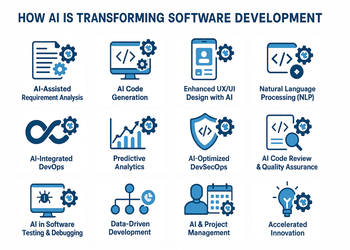
3. Enhanced UX/UI Design with AI
Enhanced UX/UI Design with AI leverages artificial intelligence to create more intuitive, engaging, and personalized user experiences. AI tools analyze user behavior, preferences, and interaction patterns to generate design recommendations, optimize layouts, and predict what features or content will improve engagement.
User experience is the foundation of every successful custom development. AI also enables personalization at scale, delivering tailored experiences for different user segments, and supports A/B testing by predicting which designs will perform better.
AI-powered tools such as Figma AI, Uizard, and Galileo are accelerating design workflows by converting prompts into functional wireframes, performing accessibility checks, and simulating user journeys informed by behavioral insights.
These AI transformations allow rapid prototyping without sacrificing creativity, alongside personalized and behavior-driven experiences that enhance usability and engagement, representing a clear AI Revolution in design processes.
4. Natural Language Processing
The way users interact with software is evolving rapidly, with voice and chat interfaces emerging as the new standard in industries. Natural Language Processing (NLP) enables machines to understand and process human language, allowing software to analyze requirements, generate code snippets, automate documentation, and build intelligent chatbots or virtual assistants.
NLP also helps extract insights from user feedback, guide feature development, and support automated testing and code review, making software development faster and more accurate. Conversational AI platforms like ChatGPT, Google Dialogflow, and Microsoft Bot Framework enable applications to understand and respond to natural human language.
This AI transformation not only enhances accessibility for users of all abilities but also provides seamless, round-the-clock customer support without delays. From smart banking apps to healthcare portals, conversational AI delivers a more engaging user experience while simultaneously streamlining operations, marking another step in the AI Revolution.
5. AI-Integrated DevOps:
AI in DevOps combines artificial intelligence with DevOps practices to enhance software development, deployment, and operations. By embedding AI into the DevOps pipeline, organizations can automate repetitive tasks, predict potential system failures, optimize resource allocation, and accelerate release cycles.
AI-powered tools analyze logs, monitor system performance, and detect anomalies in real-time, enabling proactive issue resolution and reducing downtime. AI-enhanced deployment now automates workflows, optimizes infrastructure, and strengthens continuous integration and continuous deployment CI/CD pipelines.
Tools such as Harness, Jenkins with AI plugins, GitHub Copilot, and Jira with AI plugins and Dynatrace streamline deployments, detect anomalies in real time, improve operational efficiency, and maintain high software quality.
By recognizing patterns that signal potential failures and automating recovery processes, AI significantly improves the resilience and scalability of software development. This AI transformation enables faster release cycles, allowing new features and updates to reach users quickly while minimizing deployment errors that could cause downtime or disruptions.
Automation testing in CI/CD pipelines ensures that new code integrates seamlessly without breaking existing functionality. Moreover, AI in devOps can anticipate deployment risks, detect traffic spikes, and dynamically scale resources to maintain uptime and performance, helping teams maintain a competitive edge.
6. Predictive Analytics
AI brings foresight into software systems by analyzing historical and real-time data, identifying patterns and trends, to forecast potential future outcomes. Predictive analytics enables organizations and software teams to make more informed, proactive decisions rather than relying on reactive strategies.
In software development, it helps in estimating project timelines, detecting potential risks, forecasting resource needs, and predicting user behavior or feature adoption. Tools and platforms that integrate predictive analytics, such as Power BI, Tableau, IBM SPSS, and Google Cloud AI, empower teams to anticipate challenges, optimize processes, and drive better outcomes with data-driven intelligence.
Through this AI transformation, organizations can implement data-driven personalization, optimize workflows, and plan resources intelligently for smarter project and product decisions. As a result, custom CRMs, ERPs, project management tools, and analytics dashboards evolve beyond static reports to deliver predictive insights that align closely with business objectives.
This capability represents a key aspect of the broader AI revolution in data-driven software development and decision-making.
7. AI-Optimized DevSecOps:
AI-driven software security has become crucial for protecting against cyber threats, improving vulnerability detection, automating threat analysis, and supporting secure coding practices. Its key applications include AI-powered bug detection, proactive threat modeling, and safeguarding open-source dependencies.
AI tools analyze code, configurations, and system logs in real-time to identify anomalies, misconfigurations, or risky patterns, enabling proactive risk mitigation. They also support automated security testing, continuous monitoring, and threat intelligence, ensuring that security is a continuous, integrated part of DevOps processes.
By adopting AI-driven DevSecOps, organizations can significantly reduce data breaches and overall cyber risk. Platforms like Jenkins X, Spacelift, and ArgoCD make this possible by enabling AI to predict server loads, dynamically scale infrastructure, and automate deployment pipelines with minimal human intervention.
AI empowers teams to move faster, detect issues earlier by monitoring performance, and make smarter pipeline decisions, reflecting a key AI Revolution in cyber security. Studies show that top-performing teams leveraging these practices deploy 182 times more frequently and recover from failed deployments 2,293 times faster than their lower-performing counterparts.
8. AI Code Review & Quality Assurance
AI tools are increasingly being used to automatically review pull requests, suggest improvements, detect security vulnerabilities, and recommend fixes, while ensuring adherence to coding standards and best practices. This enhances software quality and reduces human error.
They can also suggest improvements, refactor code, and generate unit tests, ensuring higher code quality and maintainability. In quality assurance, AI enhances automated testing, test case generation, defect prediction, and performance monitoring, enabling faster feedback cycles and more reliable software releases.
Automation testing complements AI review by continuously running test suites to validate code quality. The rise of AI-assisted QA represents an important AI Revolution in software quality management. Adoption is rising quickly as well. Popular tools include Codacy, DeepCode,SonarQube with AI plugins and CodeGuru.
The impact of AI-assisted code review is significant. According to Zencoder, teams using these tools have reported sixty percent fewer bugs and faster review cycles, accelerating overall development. DeviQA notes that about 44% of companies have already integrated AI into their QA processes, and this number is projected to grow rapidly.
9. AI in Software Testing and Debugging
AI testing is transforming quality by reducing human involvement and improving efficiency. It predicts, detects, and resolves software bugs before deployment while strengthening security through early identification of hidden errors, vulnerabilities, and compliance issues.
AI tools can automatically generate test cases based on code behavior, prioritize tests based on risk, detect bugs, regression tests and predict potential failure points in the code, reducing manual effort and human error.
They also assist in debugging by analyzing logs, identifying root causes, and suggesting fixes, enabling developers to resolve issues more efficiently.
AI validates encryption protocols and protects sensitive data without slowing development. Automated reviews and alerts further enable teams to address issues promptly, ensuring robust and secure applications.
Organizations are increasingly adopting AI-based debugging, AI-assisted architecture analysis, and AI-driven software analytics to identify vulnerabilities and optimize system performance. Continuous AI-driven monitoring detects anomalies and performance bottlenecks, ensuring high-quality development.
Studies from Aspiresys indicate that enabling AI transformation in testing frameworks can automate up to 80% of regression tests, reducing testing times by nearly 50%. Leading platforms such as Testim, Mabl, Applitools, and Functionize streamline processes by automating visual AI testing and performance checks.
10. Data-Driven Development Decision Making:
AI is reshaping the traditional software Development Life Cycle by streamlining the discovery and viability phases, which were once separate, time-consuming, and expensive. It uses data and analytics to guide every stage of the software development lifecycle.
By collecting and analyzing data from user behavior, system performance, application logs, and project metrics, development teams can make informed decisions on feature prioritization, resource allocation, and release planning.
It facilitates rapid prototyping and automated A/B testing, allowing teams to quickly validate hypotheses and pinpoint promising ideas. Tools like Google Analytics, Mixpanel, Jira Analytics, and Power BI enable teams to visualize insights, track key performance indicators, and continuously refine their development strategy.
Companies like Twilio and Reddit already use AI to analyze user data, monitor key metrics, and accelerate feature prototyping, representing a critical AI Revolution in strategy development. Enabling faster iterations, lower costs, and more efficient allocation of resources to high-potential initiatives.
11. AI & Project Management
AI is transforming product and project management by enabling managers to oversee the entire lifecycle from ideation to value realization. AI for project management helps teams predict timelines based on historical data, assign tasks according to expertise, forecast risks or delays, and optimize agile sprint planning.
For product managers (PMs), AI tools enable rapid prototyping, creation of marketing collateral, and development of technical proofs-of-concept with minimal reliance on designers, engineers, or product marketers.
This allows PMs to focus on strategic tasks such as long-term planning, creative problem-solving, stakeholder interviews, and use case assessment. AI also supports internal feedback by analyzing meeting notes and call transcripts, enhancing employee learning and coaching.
According to the International Institute for Learning, 22% of project managers use AI tools, with 41% reporting significant improvements in project delivery. Additionally, a Project. A survey found that 67% of respondents believe AI will substantially improve project management efficiency, and 95% expect it to moderately or significantly enhance profitability.
The expansion of managerial capabilities through AI represents a notable AI Revolution in product management. Over time, AI-driven capabilities may blur traditional role boundaries, leading to a convergence of PM, PMM, PO, TPM, and UI/UX responsibilities within product teams.
Platforms like Amplitude, Pendo, Productboard, and Mixpanel empower product managers to make data-driven decisions, anticipate customer needs, and deliver products that align closely with business goals.
12. Accelerated Innovation
AI is reshaping software engineering by redefining coding, security, and efficiency across backend, frontend, and mobile app development. Tools such as DeepMind AlphaCode and OpenAI Codex enable rapid prototyping and experimentation, helping developers explore new ideas and technologies more effectively.
These tools also play a crucial role in refactoring legacy codebases for modern platforms, accelerating the adoption of emerging technologies like AR and VR, IoT, and cloud-native solutions.
Overall, this AI transformation is fueling innovation across every aspect of software development, making the future of AI-powered applications virtually limitless. This marks the ongoing AI Revolution in innovation and technology adoption.
The Future of AI in Software Engineering
AI is reshaping software development, transitioning developers from manual coding to strategic problem-solving. Key trends include generative AI for coding, AI-powered project automation, Automation testing, AI-assisted software refactoring, AI software development.
As AI becomes more deeply integrated into applications, software architecture must evolve. Modern architectures increasingly feature micro services aligned with ML pipelines, feature stores, and model registries as core components, and versioned APIs for AI-driven endpoints.
Architects must consider model inference latency, data freshness, and retraining feedback loops, expanding software engineering roles into AIOps and MLOps domains.
Conclusion
The AI revolution is transforming software development, replacing manual coding with AI code generation, automation testing, and intelligent copilots. From AI in DevOps to AI for project management, these innovations accelerate delivery, improve quality, and enable smarter decision-making. The future of AI software development lies in seamlessly blending human expertise with intelligent automation.


